Josef Ridny’s Lamp Fire
Felix AustriaJosef Ridny’s Lamp Fire turns a silent, humiliating infatuation into a literal blaze, exposing how quickly the narrator’s fear of Josef’s attention becomes a struggle over bodily safety and control. In the Anger household’s dim attic, a dropped kerosene lamp sets fire to both their clothes; the narrator beats Josef back with a blanket, unable to say whether she means to save him or kill him. His long absence and brief letter of apology leave the episode behind as both an alarming accident and a source of jokes about the “fire of feelings” he nearly brought to the house.
Causes and Background
Before the fire, Josef’s presence had become increasingly difficult for the narrator to bear. When she brought him refreshments, he would abruptly spring up and overturn the tray; on another occasion, he spilled a bowl of oil-soaked mushrooms on her skirt. Trying to hold a door for her, he fell against his nearly blind neighbor, Chaïm Scharf, and broke Scharf’s glasses. His awkward attempts at attention repeatedly caused disruption, but the narrator experienced them not as an ordinary courtship: Josef had never spoken to her or confessed anything, yet his passion seemed to fill the air around them.
That unspoken intensity was sharpened by Adèle’s incessant teasing. The narrator felt exposed among the people around her, as if the burden of Josef’s feelings had been made public without either of them naming it. Her anger and distress belong to the circumstances leading into the fire: his attention is both mute and conspicuous, and she cannot answer a direct declaration because none has been made.
The Attic Encounter
At dusk, Docteur Anger asked the narrator to fetch books for a discussion with students. The books were stored under the roof, where even daylight struggled to penetrate the small windows. She usually searched there for Docteur Anger, who worked in his crowded office and supplied her with a list when he needed particular volumes. This time, absorbed in the discussion, he asked her to find the books and bring them to the salon. She hurried out of the office, avoiding Josef’s tearful gaze, and forgot to take a light.
Alone in the dark, she tried to read titles on the book spines and make out Docteur Anger’s writing. A noise first suggested a mouse scratching inside the wall; then it grew heavier, like the breathing of a sleeping dog or horse. The narrator froze, seized by nausea and dread, and imagined Josef behind the door, having crept up the stairs and bent beneath the low attic ceiling. She pictured his sweat, damp hands, and nervous inability either to leave unnoticed or to approach her. The narration dwells on these imagined possibilities before the door opens, making the gap between his silent longing and her alarm part of the scene’s tension.
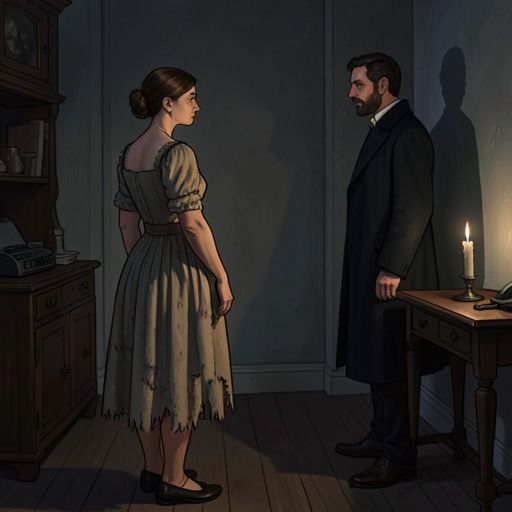
The narrator herself finally takes a few decisive steps and pulls the door open. Josef is exactly where she had imagined him: a slight figure nearly folded in two beneath the low ceiling, dark curls close to it, holding a kerosene lamp whose wavering light throws macabre shadows. He murmurs her name and explains that he has brought the lamp because she cannot see and that he will help her find the right books.
The Fire and Its Immediate Consequences
The lamp slips from Josef’s sweaty hands, falls to the floor, and shatters. Its small flame catches first at the ends of their clothes: it licks at Josef’s trouser cuffs and takes hold of the reddish trim on the narrator’s skirt, then climbs. Josef tries to smother the flames with his bare hands. In the commotion he tears off her skirt and grabs her hips; she forcefully pushes him away. He nearly loses his balance and falls onto someone already rushing to help.
The narrator seizes an old, hole-riddled blanket and strikes Josef with it, screaming at full force. The blanket is an improvised means of fighting the fire and keeping Josef at bay at once; the account does not settle which purpose governs her blows. Its unresolved final gesture gives the accident its emotional force: the narrator is caught between the danger threatening them and the unwanted contact of the man whose attention has made her feel exposed. The intimate, bodily confusion of the scene replaces the silence that had previously contained Josef’s passion.
Aftermath and Significance
After the fire, Josef disappears for a long while. The household receives only a short letter in which he apologizes for the damage. The narrator cannot remember whether she missed him during his absence; she allows that perhaps she did a little, while also recalling the relief of his departure. That ambivalence prevents the episode from resolving into a simple romantic confession or rejection: there has been no spoken declaration, only an accident that makes the pressure between them suddenly physical.
Adèle soon tires of her monotonous jokes about the “fire of feelings for Stefa” that nearly burned down the house. With the teasing gone and Josef absent, the household returns to its established routine of bickering and quarrels. Yet the apparent return to normal is brief: the narrator next recalls that Josef nearly drowned her in the pond at Romaszkan. The lamp fire therefore stands within a continuing sequence of dangerous encounters, not as a self-contained comic mishap. Its contrast between Josef’s intended assistance and the harm that follows makes the lamp a practical object turned into the agent of an uncontrolled crisis—and gives literal form to the passion that had previously been present only as an oppressive, unspoken atmosphere.